

Correlation Is a Great Party Trick
Ice cream sales and sunburn rise together every summer. Nobody sensible bans ice cream to cut skin cancer, because we all know the sun is doing the work in the background.
Most machine learning, and every large language model, is a phenomenally good correlation engine. It has seen so many patterns that it can predict what usually comes next with spooky accuracy. What it cannot do on its own is tell you which of those patterns is the cause, which is the coincidence and which is the ice cream.
Think of it like a sat-nav. One that only knows correlation will tell you the M25 is always slow at 8am. One that understands cause knows there is a lorry on its side at junction 10, knows which roads feed into it, and can route you around the problem before the queue reaches you. Same map, very different usefulness.
So What Is Causal AI?
In a nutshell, causal AI is AI that models how things relate and why, rather than just how often they turn up together.
There is a deep academic end to this field (Judea Pearl's work on causal inference is the place to start if you enjoy a bit of maths with your coffee). For organisations making real decisions, the practical version comes down to three things:
- Structure. Information is organised into entities and the relationships between them, rather than left as piles of documents.
- Evidence. Every relationship carries a plain-language reason, a confidence score and a pointer to the source that supports it.
- Challenge. A human can follow any conclusion back through the chain and decide whether they agree.
Remember your maths teacher insisting you show your working? Causal AI is the AI that finally listened.
What Is a Causal Knowledge Graph?
The engine room of causal AI is the causal knowledge graph. If you have ever watched a detective drama, you already know what one looks like. It is the pinboard covered in photos and red string, except every piece of string has a label saying why it is there and which witness statement it came from.
In practice, entities such as people, companies, places, assets, events and documents are extracted from your data and mapped into a graph of relationships. The graph is seeded from a defined ontology at the start of an implementation, so new information is sorted into known categories from the moment it arrives rather than piling up in a heap. There is a good plain-English explanation of what a causal knowledge graph is if you want the short version.
Plug a language model into that graph (Graph RAG, for those collecting acronyms) and something useful happens. Instead of retrieving a few loosely relevant paragraphs and hoping for the best, the AI answers from connected, sourced knowledge, and it can show you the path it took to get there. That combination of causal knowledge graph, Graph RAG and entity intelligence is where the real value sits.
Where We Learned This the Hard Way
We never seem to pick the easy problems.
EIOS monitors tens of millions of articles and data points every month, across global news, government bulletins and multilingual sources, and the job is to spot genuine early warning signals of disease outbreaks inside all that noise. At the centre of the platform sits a causal knowledge graph mapping millions of nodes and edges, surfacing associations that conventional search simply cannot see.
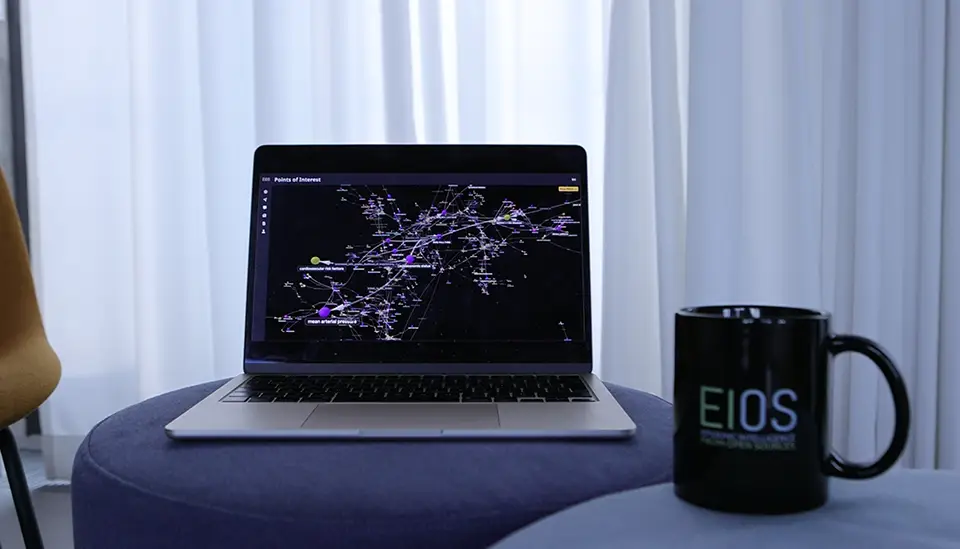
Analysts do not work from raw feeds. They work from scored, reasoned, source-linked signal cards, and administrators can tune detection sensitivity themselves without calling an engineer. When COVID-19 arrived, throughput increased tenfold within days without degrading signal quality.
Our work for the British Museum taught the same lesson from a different angle. Tracking looted antiquities across auction sites on the visible and dark web meant boiling 20TB+ of raw data down to tens of gigabytes of actionable intelligence, with every listing timestamped, screenshotted and traceable, because evidence that might support law enforcement has to stand up to scrutiny.
Both projects feature in the Causality.tools case studies if you would like the longer story.
Where Causal AI Earns Its Keep
Causal AI is overkill for choosing a lunch menu. It comes into its own when information is complex, sensitive and fast-moving, and when being wrong is expensive. The sectors where we see it earning its keep:
- Finance and fintech. Which entities are really connected to this counterparty, and what changed this week?
- Global and public health. Which signals are genuinely new, and which are the same story echoing around the internet?
- Legal and regulatory. Which obligations touch this product, and which sources say so?
- Mergers and acquisitions. Who actually owns what, once the aliases and shell companies are untangled?
- NGOs and the third sector. Where are the risks to people and programmes building up, and why?
- Public sector. Situation reports that a senior official can question line by line.
Each of these gets its own vocabulary, sources and outputs, but the reasoning underneath stays the same. There is more on causal intelligence by sector if yours is on the list.
What Causal AI Is Not
Let's be clear about a few things, because the buzzword merchants have already arrived…
- It is not a chatbot bolted onto your SharePoint. The graph does the analysis, and a chat window is just one way of asking it questions.
- It is not autonomous decision-making. The system does the heavy lifting of connecting and evidencing, and a human decides. Augmentation, not replacement.
- It is not magic. Better sources make better graphs, which is why provenance is tracked from the moment data arrives.
- It is not one-size-fits-all SaaS. Every implementation is scoped around the client's data, users and risk profile, and can run hosted, in a private cloud, on client-controlled infrastructure or fully locally with local models, depending on how sensitive the work is. The secure deployment options are laid out in detail.
Enter Causality.tools
After years of building causal systems one bespoke project at a time, we have brought that work together as Causality.tools, our causal intelligence platform. It combines causal knowledge graphs, Graph RAG, entity resolution, spatial intelligence, AI memory, risk and situation reporting and agentic workflows, and it is custom-implemented around each organisation that uses it.
The platform is modular. The implementation is tailored. Some organisations start with a single capability, like Graph RAG or entity intelligence, and a single painful question, then grow from there.
Key Takeaways
- Causal AI asks why, not just what. It models how things relate and keeps the evidence attached.
- Causal knowledge graphs are the engine. Entities, relationships, reasons, confidence scores and sources, all in one structure a human can challenge.
- Graph RAG grounds the language model. Answers come from connected, sourced knowledge rather than a lucky paragraph.
- It works at scale. EIOS monitors more than 60 million data points a month and absorbed a tenfold COVID-19 surge within days.
- Humans stay in charge. The system connects and evidences, people decide.
If you would like to see what a causal knowledge graph makes of your own data, book a discovery workshop with the Causality.tools team. They are the same friendly people you will find at Adappt, which saves everyone an introduction.
Bring your hardest question. The ice cream can stay at home.